The number one mistake people make when buying a portable power station is getting the wrong size. Too small and you're rationing power halfway through a trip. Too big and you've spent hundreds extra on capacity you never use while lugging unnecessary weight.
The math is actually simple once you understand it. This guide walks you through exactly how to calculate what you need — no electrical engineering degree required.
Step 1: Understand Watt-Hours
A power station's capacity is measured in watt-hours (Wh). This tells you how much energy it stores. The formula is straightforward:
Watts x Hours = Watt-Hours
A 60W device running for 5 hours uses 300Wh. A 10W LED light running for 10 hours uses 100Wh. Add up everything you plan to run, multiply by how long, and you know exactly how many watt-hours you need.
Step 2: Know Your Appliances
Here's what common camping and home appliances actually draw:
Low Draw (under 100W):
- Smartphone charging: 15-20W
- LED camp lights: 5-15W
- Laptop charging: 45-65W
- WiFi router: 10-15W
- CPAP machine: 30-60W
- Electric blanket: 50-75W
- Fan (portable): 30-50W
Medium Draw (100-500W):
- Mini fridge/cooler: 40-60W running (150-400W startup)
- Drone charging: 60-100W
- TV (32"): 50-70W
- Portable projector: 100-200W
- Blender: 300-500W
- Slow cooker: 200-300W
High Draw (500W+):
- Coffee maker: 600-900W
- Microwave: 800-1,200W
- Hair dryer: 1,000-1,800W
- Space heater: 750-1,500W
- Portable AC: 1,000-1,500W
- Electric grill: 1,200-1,800W
- Power tools: 500-1,800W
Step 3: Calculate Your Total
Here's a worked example for a typical weekend car camping trip:
| Device | Watts | Hours/Day | Wh/Day |
|---|---|---|---|
| Mini fridge | 50W avg | 24 hrs | 1,200 |
| Phone charging (2x) | 40W | 2 hrs | 80 |
| LED lights (3x) | 30W | 5 hrs | 150 |
| Laptop | 60W | 2 hrs | 120 |
| Portable fan | 40W | 8 hrs | 320 |
| Total per day | 1,870Wh |
[!NOTE] Refrigerators cycle on and off — they don't draw power continuously. A fridge rated at 150W typically averages 40-60W over 24 hours. The table above uses 50W average, which is realistic for a quality 12V camp fridge.
For a 2-night camping trip with this load, you'd need roughly 3,740Wh — or about 1,870Wh per day. A 1,000Wh station handles this if you recharge via solar during the day (a 200W panel produces roughly 600-1,000Wh on a sunny day). Without solar, you'd want a 2,000Wh+ station or a way to recharge from your vehicle.
Step 4: Add a Safety Buffer
Always add 20% to your calculated needs. Batteries lose efficiency in cold weather, capacity decreases over charge cycles, and you'll inevitably forget to account for something. If your math says 1,000Wh, buy at least 1,200Wh.
Also consider that LiFePO4 batteries shouldn't be regularly drained below 10-20%. While modern stations protect against deep discharge, keeping some reserve extends the battery's overall lifespan.
Step 5: Check Output Watts — Not Just Capacity
Capacity (Wh) tells you how long you can run things. Output (W) tells you what you can run at all. A 2,000Wh station with only 500W of output can't run a 900W coffee maker regardless of how much stored energy it has.
Match your highest-draw appliance to the station's continuous output rating (not peak). Peak watts handle momentary surges like compressor startups, but your station needs to sustain the running wattage.
Quick reference by output:
- 300W station: Phones, lights, fans, small electronics
- 800-1,000W station: Mini fridge, CPAP, laptop, all of the above
- 1,500-1,800W station: Coffee maker, microwave, blender, all of the above
- 2,400W+ station: Portable AC, space heater, power tools, all of the above
Step 6: Factor in Solar (If Applicable)
If you're pairing your power station with solar panels, the equation changes. A 200W solar panel produces roughly 600-1,000Wh per day (depending on sun exposure, angle, and weather). That means a 1,000Wh station paired with a 200W panel effectively gives you 1,600-2,000Wh per day — enough for most camping setups without grid charging.
Solar sizing rule of thumb: Match your daily watt-hour consumption to your panel output. If you use 1,000Wh per day, you want panels that produce at least 1,000Wh on a good day. In practice, plan for 4-5 hours of usable sun (not 8-10) to account for clouds, shade, and non-optimal panel angles.
Quick Sizing Chart
| Use Case | Recommended Capacity | Recommended Output | Our Pick |
|---|---|---|---|
| Phone/device charging only | 200-300Wh | 300W | Jackery 300 Plus |
| Weekend car camping | 500-1,000Wh | 800-1,500W | EcoFlow DELTA 2 |
| Extended camping (3+ days) | 1,000-2,000Wh | 1,500W+ | Jackery 1000 v2 |
| RV with solar | 1,500-2,000Wh | 1,800W+ | Bluetti AC180 |
| Home backup (essentials) | 1,000-2,000Wh | 1,800W+ | EcoFlow DELTA 2 |
| Home backup (extended) | 2,000-4,000Wh | 2,400W+ | Bluetti AC200L |
| Off-grid living | 4,000Wh+ | 3,000W+ | Jackery 2000 Plus |
Common Mistakes to Avoid
Buying based on peak watts instead of running watts. Peak watts only last a few seconds during motor startups. Your station needs to sustain the running wattage, which is always lower than peak.
Ignoring startup surge. Anything with a compressor (fridge, AC, freezer) draws 2-3x its running wattage when it kicks on. Make sure your station's peak wattage can handle these surges, or the unit will shut down to protect itself.
Assuming full capacity is usable. A 1,000Wh station delivers roughly 800-850Wh of usable energy after accounting for inverter efficiency (typically 85-90%). Plan accordingly.
Forgetting about temperature. LiFePO4 batteries lose 10-20% capacity in cold weather (below 32°F). If you're camping in winter, size up.
Final Thoughts
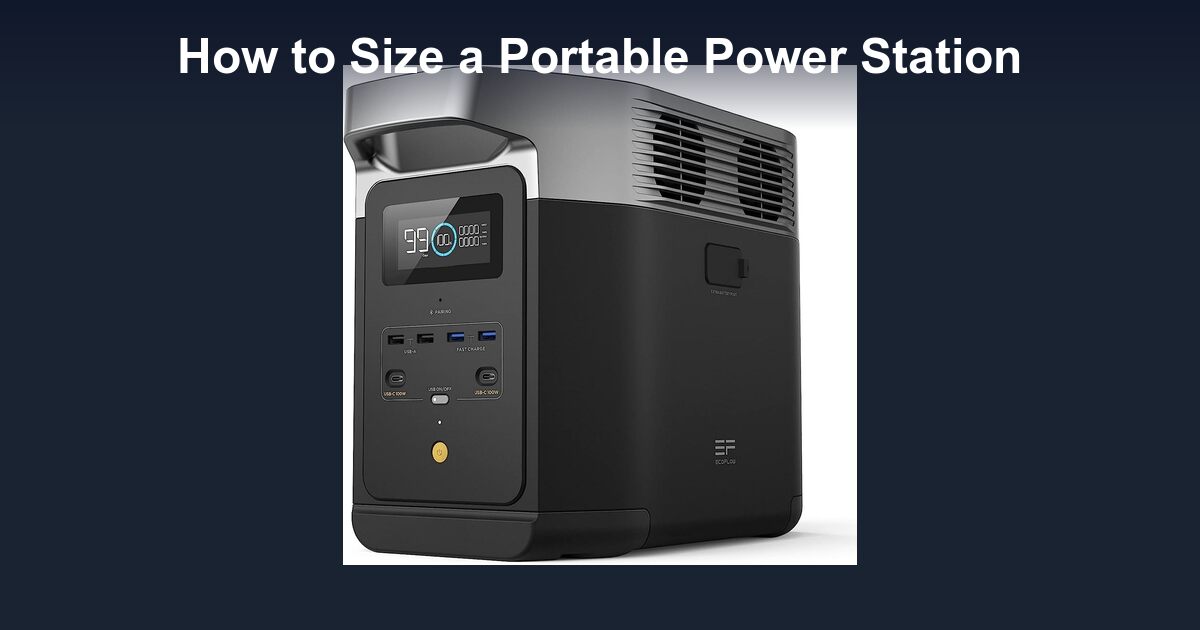
For the majority of campers, a power station in the 500-1,000Wh range handles a weekend without issue. The EcoFlow DELTA 2 — 1,024Wh, 1,800W output — is still the capacity most people should be shopping for: enough for 1-2 nights, enough output for anything short of a space heater, and fast enough charging to top off during a lunch stop.
Price note: checked 2026-09-08 — the DELTA 2 sold near $399 when this guide was written and is listed around $842 today, so we've removed the price rather than leave a number we can't stand behind. Check the current price before you buy; at this level the 2,000Wh class is worth comparing against it.
If you're going longer or running bigger loads, scale up to the 2,000Wh class. And if you're serious about off-grid time, pair any station with a folding solar panel — it turns a finite battery into a renewable system that keeps going as long as the sun does.